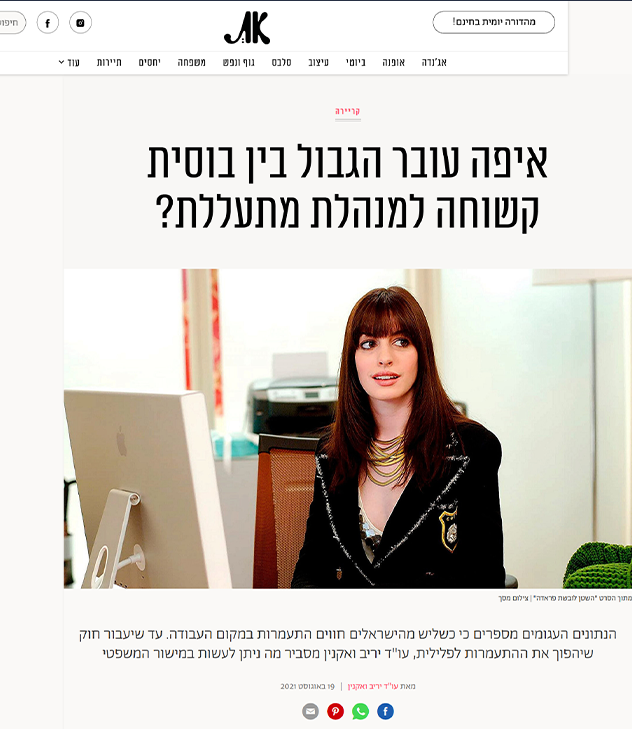

Where Is the Line Between a Tough Boss and an Abusive Manager?
- דיני עבודה וזכויות
Below is a summary of an article by Adv. Yariv Vaknin, as originally published in the Israeli magazine “At” (Et). For many of us, the workplace is our second home. We spend many hours there every day. The work environment therefore plays a major role in our lives. The data show that roughly one-third of Israelis experience workplace abuse. Adv. Yariv Vaknin explains the legal implications of this phenomenon.
At our firm, Adv. Meryam Kanaan Msalha leads this field. She heads the Labor Law and Defamation department. Our team provides legal protection in Afula and in Bnei Brak. We act to protect the rights of employees in Israel.
Definition and Forms of Workplace Abuse
Workplace abuse is a term for harmful conduct by an employer. It includes humiliation, degradation, or ridicule directed at the employee. There is no fixed profile for either an abusive manager or the targeted employee. The conduct may take a wide variety of forms.
- Brutal behavior: shouting, public humiliation, and open threats.
- Quiet undermining of the employee’s standing: false accusations and ongoing professional disparagement.
- Unreasonable demands: requests for work beyond the agreed hours.
- Demeaning assignments: tasks that do not match the employee’s training.
Legal Precedent: Compensation for Workplace Abuse in Be’er Sheva
In his article, Adv. Vaknin presents a serious example. The Be’er Sheva Labor Court awarded substantial compensation. A sales manager at a fitness club suffered humiliating, ongoing treatment. The club’s owners directed harmful and degrading remarks at her. The court ruled in her favor and awarded compensation of roughly NIS 100,000. This sum included severance pay and the realization of additional employment rights.
How Do You Prove the Claim in Court?
To win such a claim, you must establish a systematic pattern. The harmful behavior must recur on multiple occasions. It is essential to document each incident in real time.
- Recording conversations: capturing harsh words and an offensive tone.
- Preserving emails: collecting evidence of humiliating and degrading correspondence.
- Screenshots: documenting WhatsApp messages or insulting text messages.
There is currently no explicit law prohibiting workplace abuse in Israel. Claims are therefore filed under other causes of action, such as personal injury or breach of contract.